
Welcome
to Our Ag Updates: Precision & Protection
Stay informed about the latest in precision agriculture products and how we can assist you in optimizing your operations. Discover the range of custom maps we create and their practical benefits for your farm. This section also provides insights into crop insurance options, helping you choose the best fit for your specific farming needs.
BEFORE THE COMBINE ROLLS:
Insurance To-Dos
Just a quick reminder—give me a call before you start chopping or harvesting so I can loop in an adjuster.
This includes:
-
Corn chopped for silage or acres sold for silage
-
High-moisture corn harvesting
-
On-farm grain storage that includes prior year’s grain or combines multiple units
If you experience damage or suspect a loss, notify me within 72 hours of discovery.
Is Variable Rate Planting Worth It
Making Every Seed Count
What Is Variable Rate Planting (VRA)?
VRA uses data like soil type, yield history, and topography to automatically adjust seeding rates within each field zone — putting more seed where conditions are best and saving seed where yields are limited.
The ROI Case
Benefit | Value
--------|------
-
Optimized Yield | Higher seeding rates in productive zones = more bushels per acre
-
Seed Savings | Lower seeding rates in low-potential areas = fewer wasted inputs
-
Better Profitability | Smart planting = higher returns per dollar of seed
-
Reduced Risk | Avoid overpopulation in poor zones = less disease & stress pressure
-
Consistent Emergence | Tailored rates match soil conditions, improving stand uniformity
Common Objection:
"My ground doesn’t vary that much."
But it does — even small changes in soil texture, drainage, or slope can impact yield. You’re already seeing this in your yield maps. VRA makes sure your seeding plan matches that variability — automatically and precisely.
Real-World Results
- 2–8 bu/acre gain in corn from properly tuned VRA
- 1,000–2,000 seeds/acre savings in poorer zones
- Payback in 1–2 years on most farms with average yield gain
What You Need
- A planter with rate control
- A planting prescription map (we help with that)
- Yield maps or soil data (or both!)
Let Every Acre Reach Its Potential
VRA isn’t about changing everything — it’s about getting more from what you already have. Whether you farm
flat ground or rolling hills, VRA makes your planter smarter and your acres more profitable.
Need Help Getting Started?
Ask us today!
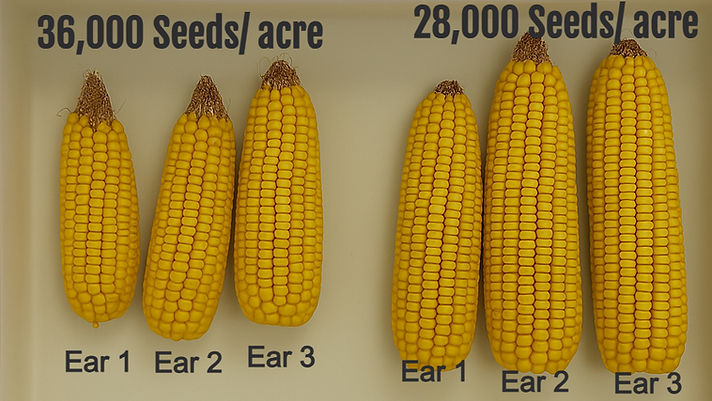
Variable Rate Planting Population
DKC54-38RIB
Flex ear type average 18 row around
36,000 seeds per acre
-
Ear 1
-
18 around
-
27 long
-
-
Ear 2
-
16 around
-
26 long
-
-
Ear 3
-
20 around
-
27 long
-
192 bu/acre
28,000 seeds per acre
205 bu/acre
Total Difference
13 bu/acre
8,000 sd/acre
or
1/10 of a bag
Why Grid Soil Sampling Pays Off
More Data = Smarter Fertility Decisions
What Is Grid Sampling?
Grid sampling breaks a field into small, uniform zones (usually 1 to 2.5 acres) and takes a soil sample from each. This gives you a detailed fertility map of your entire field.
The Payoff: What You Get
Benefit | Value
--------|------
-
Accurate Fertility Map | You see exactly where you're high or low on nutrients
-
Targeted Fertilizer Use | Put nutrients where they’re needed, cut back where they’re not
-
Improved Yields | Avoid limiting nutrients in low areas, unlock full potential in high zones
-
Better Decisions | Builds a multi-year record of soil trends and ROI by zone
-
Avoid Overapplication | Prevent waste of $500–$800/ton fertilizer on already-high zones
Common Objection:
"I already sample by soil type or management zone."
That’s a great start — but grid sampling finds hidden variability that those methods can miss. Especially on
glacial soils like in SW MN, fertility doesn't always follow soil type lines.
Real-World Results
- $20–$30/acre ROI over broadcast programs
- Many growers find enough savings in one pass to pay for the sampling
- Unlocks VRT (Variable Rate Technology) for lime, P, K, and even seed
Precision = Profit
Fertilizer is one of your biggest input costs. Grid sampling makes sure every dollar of it works harder — and
helps you build fertility, not just maintain it.
Need Help Getting Started?
Ask us today!